
Joo Chiat Singapore: A Colourful Historic Community

Joo Chiat’s story begins well before its colourful façades became familiar landmarks. In the 1820s, the wider area was largely occupied by coconut and cotton plantations, villages and seaside bungalows. From around 1900, Singapore’s growing population began moving beyond the city centre, and the east developed into a residential district with new roads, homes, schools, places of worship and businesses.
The neighbourhood took its name from Chew Joo Chiat, a landowner and philanthropist whose property holdings helped shape the area’s development. Yet Joo Chiat’s identity was never created by one person or one community alone. Peranakan, Eurasian, Chinese, Malay, Indian and other residents contributed to its social fabric, leaving traces in its architecture, food, institutions and street names.
In 2011, Joo Chiat was designated Singapore’s first Heritage Town. That recognition reflects a defining quality of the area: history here is not isolated behind museum walls. It remains visible in homes, family businesses, religious buildings and everyday routines.
Peranakan Heritage in Joo Chiat
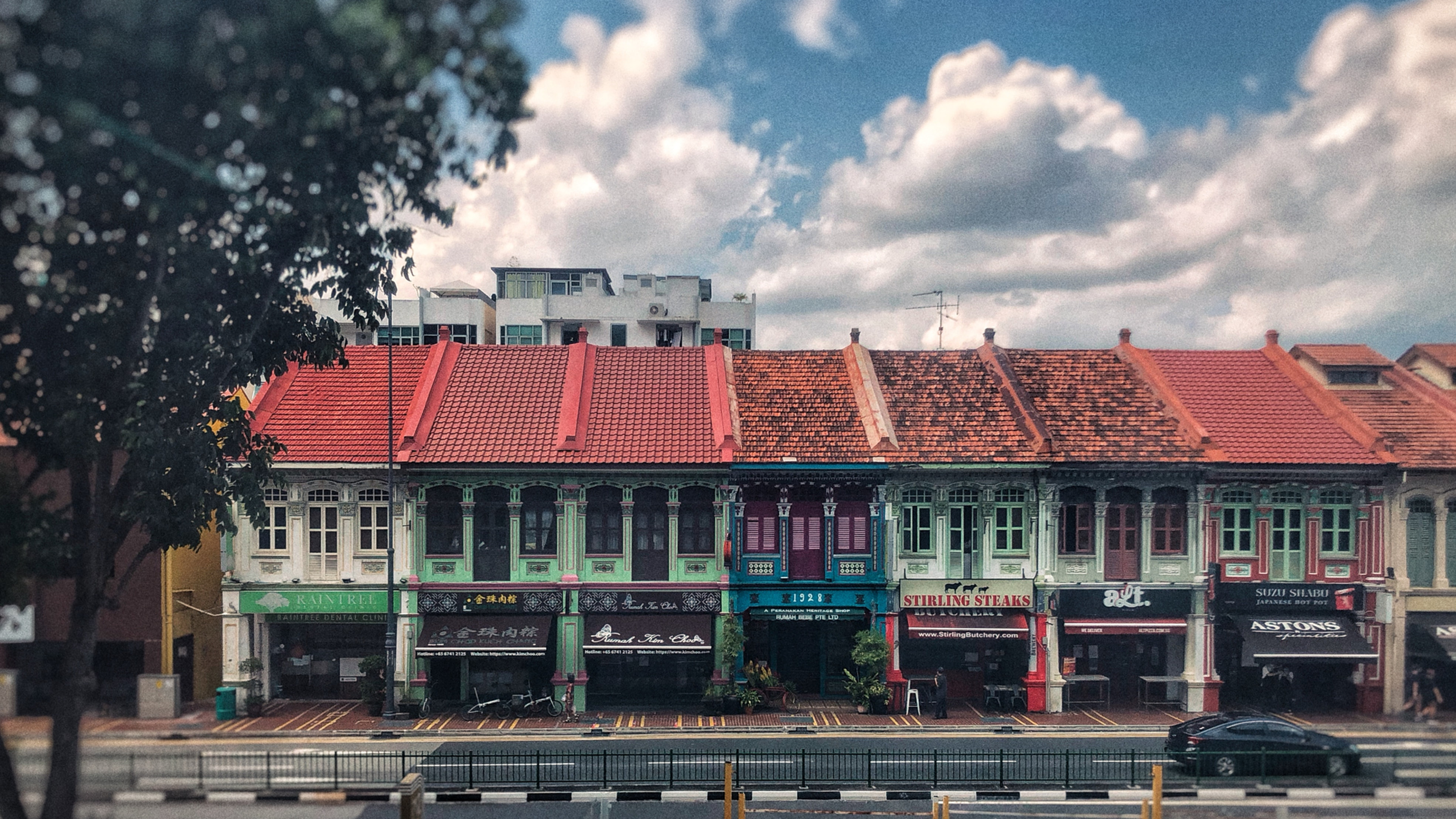
Joo Chiat is strongly associated with Peranakan culture. In Singapore, the term commonly describes communities formed through generations of cultural exchange in Southeast Asia, including the Peranakan Chinese, whose traditions blended Chinese roots with local Malay and regional influences.
This heritage can be encountered through design, language, clothing, craft and cuisine. Decorative tiles, carved timber screens, floral motifs and ornate plasterwork reflect both changing tastes and the aspirations of earlier residents. Beaded shoes, embroidered garments and household objects reveal painstaking craftsmanship, while family recipes preserve knowledge through smell, taste and technique.
At the same time, it is important not to reduce Joo Chiat to a single cultural label. Its Peranakan character is central, but the neighbourhood’s wider story includes Eurasian institutions, diverse places of worship, generations of migrants and businesses serving an evolving population. Seeing these layers together gives learners a more complete understanding of Singapore’s multicultural development.
The Stories Behind Joo Chiat’s Colourful Shophouses
For many visitors, Joo Chiat’s shophouses provide the first visual introduction to the neighbourhood. Rows of low-rise buildings create a streetscape on a human scale, while pastel colours, patterned tiles, decorative mouldings and timber shutters reward close observation.
These buildings are not all identical. The conservation area contains mainly two-storey shophouses and terrace houses representing Transitional, Late and Art Deco styles, alongside examples of simple Modern architecture. Together, they show how building design changed from the early to the mid-20th century.
The shophouse form also demonstrates how architecture responds to climate and urban life. A typical unit combines a narrow frontage with a deep interior, while covered five-foot ways provide shade and shelter at street level. Historically, the combination of commercial space below and living quarters above allowed work, home and community life to overlap.
For young learners, the façades can become an outdoor visual exercise. What symbols repeat from one building to another? Which details appear handmade? How do windows, ventilation openings and sheltered walkways respond to Singapore’s weather? Comparing neighbouring units encourages careful observation and shows that architecture can be read as evidence of social history.
Food as a Window into Community and Culture

Joo Chiat’s food culture is equally valuable as a record of the past. Recipes move through families, ingredients reveal regional connections, and preparation techniques preserve knowledge that may never have been written down.
Peranakan dishes are among the area’s best-known culinary traditions, but the neighbourhood’s appeal extends across kopitiams, bakeries, noodle shops, cafés and long-running family businesses. Laksa, popiah, kueh, rice dumplings and other familiar foods can open conversations about migration, trade, adaptation and identity.
Consider popiah as an example. Its thin skin, carefully prepared filling and shared style of eating contain stories about craftsmanship and family enterprise. Kway Guan Huat Joo Chiat Popiah began in 1938, while Kim Choo Kueh Chang traces its roots to a roadside stall founded in 1945. Their histories show how food businesses can adapt over generations while continuing to carry cultural memory.
Food heritage is therefore not only about tasting a signature dish. It is also about asking who makes it, how skills are learned, why recipes change and what keeps customers returning. These questions transform a meal into a lesson about continuity and change.
How Conservation Keeps the Neighbourhood Alive
The Joo Chiat Conservation Area received conservation status on 23 July 1993, with additional buildings protected in later years. Conservation helps retain significant shophouses, terrace houses, bungalows and places of worship, preserving a streetscape that records the area’s architectural evolution.
But conservation does not mean freezing a neighbourhood in time. Joo Chiat continues to function as both a residential district and a commercial destination. Traditional trades sit beside contemporary cafés, studios and independent shops. Residents still use the same streets that visitors come to photograph.
This balance is what makes the area a useful case study. Buildings need appropriate restoration, but a thriving heritage district also depends on viable businesses, considerate visitors and communities that continue to find meaning in the place. When old structures support new uses without losing their defining character, conservation becomes part of everyday life rather than an exercise in nostalgia.
Community Identity Beyond the Postcard

It is easy to experience Joo Chiat only as a backdrop of colourful façades. Yet its strongest stories emerge when attention shifts from landmarks to relationships: a family recipe passed down through three generations, a sheltered walkway shared by neighbours, a place of worship serving an established community, or an independent shop contributing to the character of its street.
Joo Chiat Street Social made these relationships unusually visible by allowing people and local businesses to occupy a road normally dominated by vehicles. More than 80 neighbourhood merchants participated across activities involving food, culture, fitness, arts and community life. The occasion was temporary, but the principle is enduring: public space can strengthen belonging when people are invited to meet, move and participate together.
For families and school groups, this is an opportunity to discuss what makes a neighbourhood feel distinctive. Is identity created by its buildings, its people, its activities or the memories attached to it? In Joo Chiat, the answer is all of these at once.
Turn Joo Chiat into an Educational Experience
A learning journey through Joo Chiat can connect multiple subjects within a single walk. History becomes visible through settlement patterns and old photographs. Art and design emerge in tiles, typography and ornament. Geography appears in the neighbourhood’s changing relationship with the coast. Social studies comes alive through questions about migration, multiculturalism, conservation and shared spaces.
Students can practise observation by recording architectural details, comparing old and new uses, or identifying evidence of cultural exchange. They can develop inquiry skills by asking why certain buildings were conserved, how family businesses transfer knowledge, and whose stories are represented in the streetscape.
The experience can continue after the visit. Learners might create a visual glossary of architectural features, map examples of tangible and intangible heritage, interview relatives about food traditions, or propose ways to keep a historic neighbourhood welcoming and relevant. These activities connect place-based discovery with reflection, communication and critical thinking.
Plan Your Joo Chiat Learning Journey
Joo Chiat shows that Singapore’s heritage is not confined to monuments. It lives in streets designed for shade and sociability, in recipes refined over decades, in conserved buildings adapted for present-day use, and in the communities that give these places meaning.
For educators, the neighbourhood offers a rich setting for learning outside the classroom. For families, it provides an accessible way to explore Singapore through stories, architecture and food. A guided experience can help participants look beyond the most photographed façades and understand how the different layers fit together.
Bring Joo Chiat’s living heritage to life for your students. Explore LHL’s Joo Chiat Learning Journey and enquire about a school programme.
Families can also discover the neighbourhood through an LHL guided, story-rich learning experience.